Nigeria installed 803 megawatts of new solar capacity in 2025, making it the second largest solar market in Africa. But installation figures only tell part of the story. Discover how an improperly sized solar system can cost more than it saves...
The Hidden Cost of Solar Installations in Nigeria
Nigeria installed 803 megawatts of new solar capacity in 2025, according to the Global Solar Council, making it the second largest solar market in Africa behind South Africa. This growth is real, but installation figures measure how much solar has been deployed, and not the suitability of those systems. A dangerously growing section of the Nigerian solar market is now dealing with a less conspicuous problem - hidden costs from improperly sized solar systems.
The Renewable Energy Association of Nigeria (REAN) flagged this issue in its 2025 energy audit which covered 1000 women-led micro and small enterprises across Lagos and Abuja. Among its recommendations to solar providers was a clear set of instructions: do not oversize the system; tailor-fit solutions to each business. What’s the worst that could result from oversizing a system? One could even assume it’s more beneficial. The higher the quality, the longer it lasts; right? Unfortunately, that’s not how it works.
Let's talk about the more apparent issue -undersized systems
A household installs solar expecting to limit generator usage, only to discover that the inverter trips once heavier appliances come on or that the battery is exhausted before they go to bed. The system works, but not at the level the customer expected. Generator hours drop but not as much as is expected. Fuel purchases hold steady. Electricity bills remain largely unchanged. Solar becomes an addition to the energy crisis, instead of a solution.
The financial effect compounds quickly. Residential solar systems in Lagos range from roughly N2.5 million for a medium setup covering fridges, fans, and basic lighting, to N8 million or more for higher capacity systems running air conditioning and heavy appliances, according to market estimates reported by Nairametrics. That capital outlay is typically justified by the fuel costs it eliminates. A household spending N50,000 to N100,000 monthly on generator fuel expects solar to absorb most of that load, reducing or ending diesel purchases and paying back the investment over three to five years. If the system is undersized and the generator continues running for several hours daily, those fuel savings shrink sharply. The payback period stretches. The investment that was meant to replace an ongoing cost becomes an additional one.
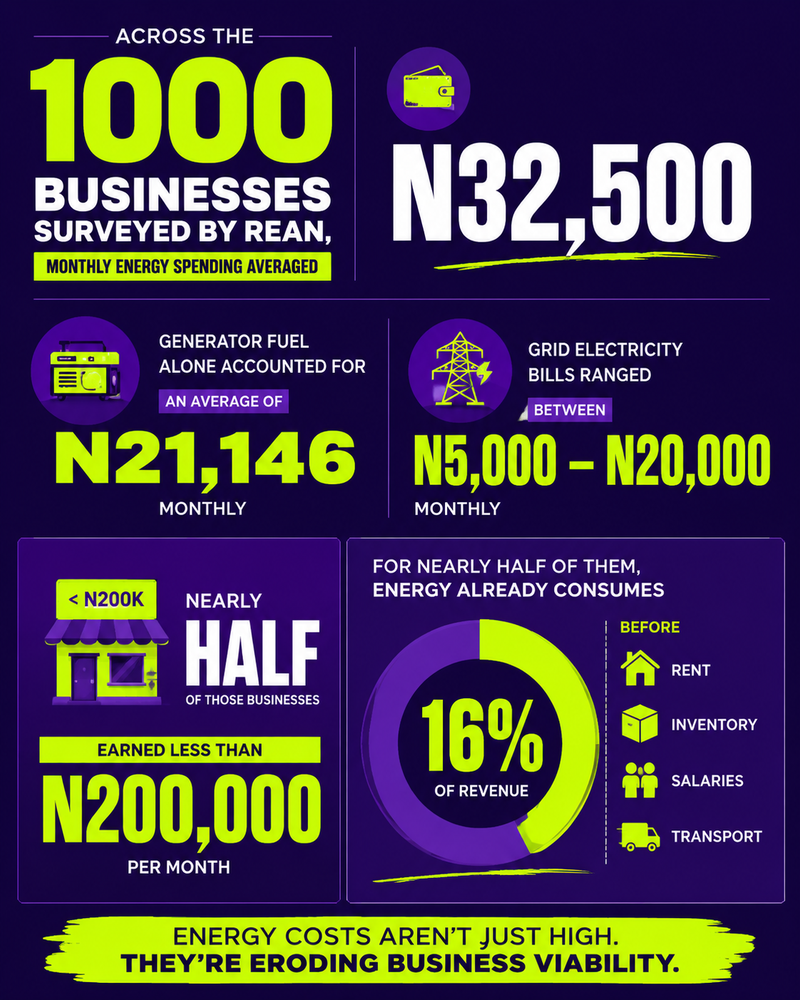
Across the 1000 businesses surveyed by REAN, monthly energy spending averaged N32,500. Generator fuel alone accounted for an average of N21,146 monthly, while grid electricity bills ranged between N5,000 and N20,000. Nearly half of those businesses earned less than N200,000 per month. For nearly half of them, energy already consumes 16% of revenue before rent, inventory, salaries, or transport are considered. An undersized system that fails to meaningfully reduce generator usage defeats the purpose and even further complicates the cost.
Now onto the less observable issue of system oversizing
Oversizing creates both financial and technical challenges. A system that is too large for a household's actual consumption produces more electricity than the household regularly uses, and in Nigeria's current regulatory environment, that surplus usually cannot be sold back to the grid. In Kenya, formal net metering regulations already allow approved systems to receive credits for surplus generation exported to the grid. In South Africa, households in parts of the country can export excess electricity under municipal and small-scale embedded generation frameworks. Nigeria’s residential export market remains far less developed. The Nigerian Electricity Regulatory Commission, NERC published draft net billing regulations in September 2025, but residential surplus export remains limited in practice, so excess generation often goes unused. The financial cost is straightforward: households pay upfront for capacity they do not fully need.
The technical consequence of oversizing solar inverter systems receives less attention. Research on off-grid solar systems across sub-Saharan Africa, cited by IndexBox in February 2026, found that underutilised systems frequently experience suboptimal battery cycling, which can shorten battery lifespan and increase the long-term cost per unit of electricity generated. A household that installs a 10kW system when a 5kW system would have covered its actual demand is not only paying for excess capacity, but also reducing the useful life of the batteries it paid for.
The underlying issue in both cases is usually the same: poor load assessment.
Many installers, particularly at the residential and small scale end of the market, are still sizing systems using rough estimates or customer budgets rather than measured electricity consumption. The REAN audit illustrates the mistakes that could result from this method of system sizing. Based on measured load profiles from the survey, a small provision shop consuming 3.98 kilowatt-hours daily would need roughly four 400-watt panels, three 100Ah lithium batteries, and a 1,500-watt inverter. While a beer parlour consuming 15.71 kilowatt-hours daily would need ten panels, eight batteries, and a 4,000-watt inverter. An installer sizing a system for the provision shop with that of a beer parlour which he had set up previously ends up providing excess capacity, which the business owner would pay for but never use. A beer parlour fitted with the provision shop's system runs short before the day ends and the generator ends up getting warmed.
The consequences are even graver when debt financing enters the picture
Many Nigerian households and small businesses fund solar installations through loans or by liquidating savings. REAN estimates that solar financing in Nigeria typically carries interest rates ranging between 12 and 25 percent. If the system underperforms because it was improperly sized, resizing later usually means spending additional capital after the original investment has already been committed, or taking on much more debt than required which could have been invested into more productive use.
Nigeria's installed solar capacity grew by 141 percent in 2025. That is a significant deployment figure. But installed capacity alone does not measure whether households and businesses are actually reducing their energy costs in practice. For many Nigerians investing in solar, the financial outcome depends less on whether panels were installed and more on whether the system was correctly sized before the money changed hands. Before any contract is signed, it is essential to engage a professional to perform an energy audit, in order to recommend an appropriate system size for your unique needs. But before you do that, you can independently estimate your required system specifications, its cost, payback period, and general financial implications in just a few minutes by utilizing an online solar calculator. A number of these tools exist, specifically engineered for the Nigerian market. We have ranked the top 5 in our article linked.
Sources: Renewable Energy Association of Nigeria, Empowering Women Entrepreneurs Through Energy Audits, November 2025; Global Solar Council via African Energy, 2025; Nairametrics, 2025; NERC Draft Net Billing Regulations, September 2025; IndexBox, February 2026.

Fabian Omini
Energy Analyst
Fabian Omini is an energy analyst with a keen interest in translating complex energy and finance topics into clear, accessible narratives for everyday Africans.