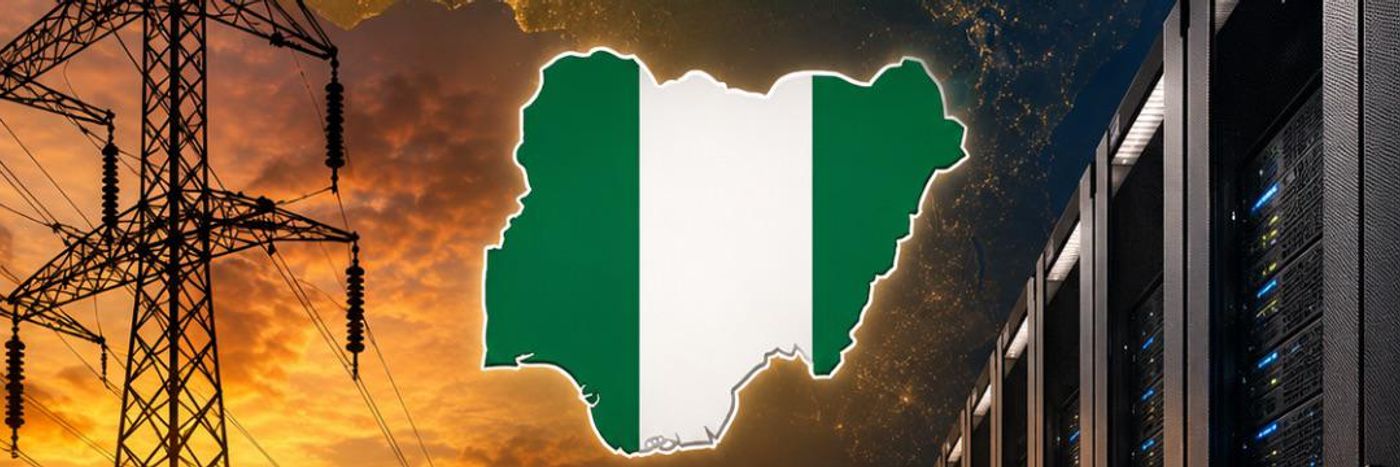
Nigeria aims to become Africa’s data hub with 300MW+ capacity by 2030, but unreliable power and high diesel costs remain major hurdles. Why gas and solar may matter for data center growth.
Nigeria Wants to Be Africa’s Data Hub. Its Power Problem May Decide Whether That Happens
Every time a Nigerian uses mobile banking, streams a video, processes payroll, or sends a message across the internet, that transaction passes through a data center. A data center is a facility housing the servers, storage systems, and networking equipment that store, process, and move digital information.
Nigeria’s digital economy is growing fast enough that the country now has 21 operational data centers with a combined installed capacity exceeding 30 megawatts. Industry forecasts suggest that capacity could exceed 300 megawatts by 2030 as demand for cloud computing, digital payments, artificial intelligence infrastructure, and local data processing continues to grow. Global operators including Equinix, Digital Realty, Rack Centre, Open Access Data Centres, and Africa Data Centres are all active in the market.
In March 2026, Tetracore Energy Group announced a $400 million data center project in Ogun State backed by Huawei and Inspirive Technologies, alongside a dedicated 100MW gas-based power plant designed to support operations independently of the grid.
The investment is real. The constraint underneath it is also real, and it is the same constraint that has followed Nigerian infrastructure for decades: power.
A data center cannot go dark
Banks do not have offline hours. Payment systems do not pause for scheduled maintenance. A facility serving financial institutions, telecommunications companies, and enterprise clients must maintain very high uptime standards.
In Nigeria, achieving that level of reliability from the national grid alone is not currently feasible. Although the country has more than 13,000 megawatts of installed generation capacity, average available generation typically fluctuates between 4,000 and 6,000 megawatts. For facilities that require uninterrupted service, that gap between installed and available capacity creates a significant reliability challenge.
Diesel has long been the default solution. It is also an expensive one. Energy costs account for more than 35% of data center operating expenditure in Nigeria. Diesel-powered electricity costs operators between N500 per kilowatt-hour and above, up from roughly N300 per kilowatt-hour in 2023. A named source at MainOne told BusinessDay that total operational costs for running a Nigerian data center rose significantly in the period following the removal of fuel subsidies in 2023. Fuel price volatility, exchange rate movements, and maintenance costs associated with generator fleets remain structural pressures on operators.
The shift the industry has made in response is toward gas
MTN Nigeria has deployed gas-powered generation systems at select facilities and reported significant efficiency gains compared to diesel, according to industry reporting. Rack Centre’s 12MW LG2 facility, which came online in 2025, operates on a hybrid diesel and gas configuration designed to improve efficiency and reliability. The Tetracore project in Ogun State goes further, embedding a large-scale gas power solution within the facility complex itself to guarantee uptime independent of the distribution network. Nigeria holds more than 200 trillion cubic feet of proven natural gas reserves, the largest in Africa, making gas-to-power the most immediately scalable bridge between current grid limitations and data center requirements.
Renewable energy presents a more complex trade-off. Solar can reduce fuel consumption and support data center operations, but facilities serving banks, telecommunications companies, and cloud providers require continuous power. Achieving that standard with solar requires substantial battery storage and backup generation, increasing both cost and system complexity. No major Nigerian data center operator currently relies on solar as a primary energy source, though some operators have indicated that renewables may form part of future energy mixes.
What this energy story tells Nigerians is not abstract
Data centers are the backbone of the financial services, telecommunications, healthcare, and e-commerce systems that Nigerians depend on daily. When those systems are expensive to operate, the cost moves through the value chain. BusinessDay reporting cites industry estimates of a significant gap between Nigeria’s current data center capacity and what is required to meet demand. That gap reflects both rising digital consumption and the structural constraints of powering large-scale digital infrastructure reliably.
The investment flowing into the sector suggests operators believe that constraint can be overcome. Equinix, Digital Realty, and other global infrastructure providers are making long-term bets on Nigeria’s digital trajectory. Those bets rest on a shared assumption: that the country’s energy infrastructure will improve enough to support the digital economy it is trying to build. Nigeria’s gas reserves offer a realistic near-term pathway to powering data centers at scale. Whether that pathway is developed quickly enough to match rising demand is the question the next phase of growth will answer.
Sources: Ecofin Agency, Nigerians’ Booming Data Centers Market Poses Power Supply Test, February 2026; BusinessDay, Rising Energy Costs Hamper Data Center Growth in Nigeria, September 2024; Connecting Africa, Nigeria’s Data Center Growth Prospects Amid Power Constraints, June 2025; Guardian Nigeria, Nigeria’s Gas to Power Global AI Boom, June 2026; Aggreko, Powering the Largest Data Center in Nigeria When It Can’t Rely on the Grid; Research and Markets, Nigeria Data Center Market Investment Analysis and Growth Opportunities 2026–2031, February 2026; Punch Newspapers, Huawei, Tetracore Collaborate on $400m Energy-Digital Project, March 2026.

Fabian Omini
Energy Analyst
Fabian Omini is an energy analyst with a keen interest in translating complex energy and finance topics into clear, accessible narratives for everyday Africans.